When a Child Can't Talk at School: Where Teachers Can Start
For most children, school is filled with opportunities to communicate. They ask questions, share stories, make friends, and participate in classroom discussions. But for children with selective mutism (SM), these everyday interactions can feel incredibly difficult.
A child with selective mutism might talk nonstop at home, tell elaborate stories, and happily boss their siblings around, yet struggle to say a single word to their teacher. Another child might chat with friends on the playground but become completely silent when an adult joins the conversation.
These differences can be confusing, especially when a child otherwise seems happy, engaged, and comfortable at school. The good news is that teachers can play an incredibly important role in helping children with selective mutism build their communication skills. And they don't need to become therapists to make a meaningful difference.
Understanding Selective Mutism in the Classroom
Selective mutism is an anxiety disorder that makes it difficult for children to speak in certain situations, despite being able to speak comfortably in others. Children with SM aren't choosing when to speak. Anxiety affects their ability to communicate, and even small changes in the environment can make speaking feel significantly harder. For example, a child may speak freely with a classmate during recess but struggle to answer that same classmate's question during circle time. Another may whisper to a teacher when they're alone but be unable to speak when other children are nearby.
It's natural to assume that a child who isn't speaking simply needs more time to warm up. And while building comfort is an important part of helping children with SM, waiting for them to become comfortable doesn't necessarily mean speech will follow. Over time, children can develop established patterns of who they speak to, where they speak, and what types of communication feel possible. Helping children move beyond these patterns takes intentional support.
So where should teachers begin?
Start With Connection, Not Conversation
When a child isn't speaking, adults often feel an understandable urge to encourage them to talk. They might ask easy questions, offer choices, or reassure the child that it's okay to answer. However, even well-intentioned questions can feel like pressure when a child is struggling with anxiety. Instead, we encourage teachers to begin by building a positive relationship without making speech the center of attention.
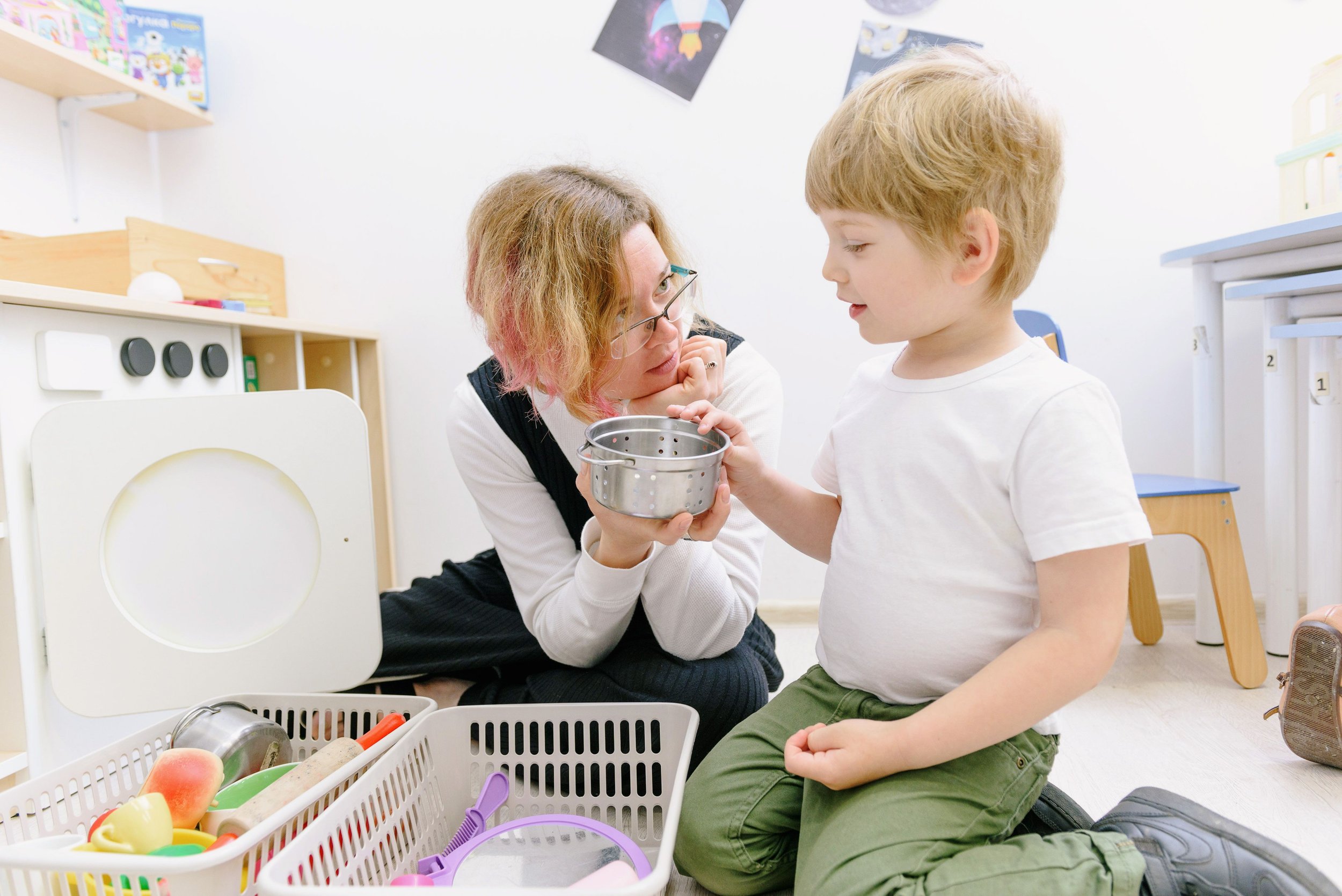
One way to do this is through child-directed interactions, a strategy used in Parent-Child Interaction Therapy adapted for Selective Mutism (PCIT-SM). Rather than leading the interaction with questions or instructions, the adult follows the child's lead and comments on what they're doing.
For example, during a classroom activity, a teacher might say:
"You picked the purple marker for your picture."
"You're working really carefully on that tower."
"You figured out where that puzzle piece goes!"
Teachers can also reflect any spontaneous speech that occurs. If a child comments, "I made a house," the teacher might respond, "You made a house with a big front door!"
These interactions may seem simple, but they accomplish something important. They allow the child to experience positive interactions with the teacher without feeling that every interaction comes with an expectation to speak. And when a child does speak spontaneously, there's no need to make a big deal out of it, but a warm, natural praise helps communication become a more comfortable part of the relationship. We love the praise statements: “I appreciate you sharing” or “It’s so nice to know what you need.”
Recognize That Participation Is More Than Speaking
When a child has selective mutism, it's easy to focus on whether they're talking. But speech is only one part of classroom participation. For a child who is struggling with anxiety, walking into the classroom independently, joining a group game, approaching a teacher, or participating in a classroom routine may represent meaningful progress. Teachers can help by creating opportunities for children to become increasingly involved in their classroom environment.
For example:
Invite the child to help distribute classroom materials.
Encourage participation in activities that don't initially require speaking.
Give the child a classroom responsibility, such as collecting folders or organizing supplies.
Notice and praise efforts to join peers or participate in group activities.
A teacher might say, "You joined your group and got right to work!" or "You helped everyone get their supplies ready!" These small moments help children build confidence in their ability to participate and connect with the people around them. Importantly, behavioral participation is a starting point, not the end goal. As children become more comfortable, we want to help them gradually build their ability to communicate verbally as well.
Small Changes Can Make a Big Difference
Teachers are balancing the needs of an entire classroom, and supporting a child with selective mutism shouldn't require completely changing the way they teach. In fact, some of the most helpful strategies are small adjustments to everyday interactions.
Spend a few minutes alongside the child during an activity they enjoy. Make comments instead of asking a series of questions. Look for opportunities to praise participation. Help the child become involved with classmates without immediately expecting conversation. Most importantly, remember that building comfort doesn't mean avoiding all challenges. It means creating a foundation from which children can begin taking increasingly difficult communication steps. As that foundation develops, teachers, parents, and the child's treatment team can work together to identify realistic speaking goals and opportunities to practice them throughout the school day.
Helping Children Find Their Voice at School
Children with selective mutism benefit when the adults in their lives understand that communication difficulties aren't a matter of choice, and that progress involves more than simply waiting for a child to speak. Teachers don't need to get every interaction exactly right. What matters is creating consistent opportunities for connection, participation, and eventually, verbal communication.
At Growing Minds Psychology, we work closely with families and schools to help children with selective mutism build communication skills where they need them most. Through teacher training, school consultation, and individualized school-based support, we help educators become active partners in that process.
The goal isn't just for children to feel comfortable in their classrooms. It's for them to be able to participate, build friendships, share their ideas, and let the people around them get to know who they really are.