Recommended Resources
We’re building this resource library with recommended books, websites, organizations, and other materials that we have found helpful for children, teens, and families. New resources will be added regularly. Please check back soon as we continue to expand this collection.
Parent Books
Overcoming Dyslexia (2nd ed.) by Sally Shaywitz and Jonathan Shaywitz
Conquering Dyslexia by Jan Hasbrouck
Dyslexia Advocate! (2nd ed.) by Kelli Sandman-Hurley
Child Books
A Walk in the Words by Hudson Tallbot
The Alphabet War: A Story About Dyslexia by Diane Burton Robb
Brilliant Bea by Shaina Rudolph & Mary Vukadinovich
Organizations and Online Resources

The International Dyslexia Association

National Center on Improving Literacy
Yale Center for Dyslexia and Creativity

Good grades don't always tell the whole story. In this first installment of our Things Parents Hear That Aren’t Quite Right series, we explore why understanding how a child learns can be just as important as what they achieve. Through a neuropsychological lens, we look beyond the report card to better understand the effort, strategies, and support that may be shaping a child's success.
Special education can feel confusing and overwhelming, especially with so many myths and mixed messages. We break down common misconceptions and explain what special education really means so you can confidently advocate for the support your child needs and better understand your role in the process. With the right information, navigating the system becomes much more manageable.
If your child rereads and highlights but still struggles to remember what they study, they’re far from alone. Effective learning depends on active strategies—not passive ones—and students often need explicit teaching in how to preview, process, and explain new information. With the right tools and guidance, kids develop stronger comprehension and study habits that support them well beyond a single test.
When a child is avoiding doing their homework or procrastinating getting started, it is easy to come to the conclusion that they lack the motivation to get it done. Then, you offer an incentive to try and spark some sort of progress— “You can have an extra hour of screen time as soon as you get your homework done.” Not budging? There may be something a bit more complicated in play. Task avoidance is often caused by challenges with crucial emotional and executive functioning abilities.
Often times, children with learning difficulties experience heightened symptoms of anxiety. The academic struggles combined with (real or imagined) social, emotional, or behavioral fears can become debilitating for a child. As a parent, it is hard to see your child suffering academically, emotionally, and socially. Therefore, gaining a better understanding of the connection between learning disorders and anxiety is a vital step in aiding your child and increasing their confidence and overall ability.
Dyslexia is a language-based learning disability that affects reading, writing, and spelling. When families seek out an evaluation due to concerns about their child’s reading or writing performance, dyslexia is one of the primary diagnoses that comes to mind for many practitioners. About 85% of students referred for special education services are students with literacy difficulties that may be dyslexia. Dyslexia is the most common learning disability.Given its prevalence, it is perhaps surprising that there are still many myths that persist.
If your child has had difficulties in school or you have concerns about their development, you have likely been referred for a neuropsychological evaluation. To many parents, this daunting, new recommendation has you imagining your child hooked up to machines for neurological imaging and observation. When in fact, these evaluations require no fancy machines and are often fun for kids. We want to answer common parent questions about these evaluations and clear up the confusion.
Many children require additional support in school for a variety of reasons. However, the education system can be difficult to navigate. Since parents are the primary advocate for their children, it is important to understand what is available, how to obtain services, and which services are appropriate for your child.
Parent Books
12 Principles for Raising a Child with ADHD by Russell A. Barkley
Straight Talk About ADHD in Girls by Stephen P. Hinshaw
Getting Ahead of ADHD: What Next-Generation Science Says about Treatments That Work by Joel Nigg
Child Books
Different Thinkers: ADHD by Katia Fredriksen and Yael Rothman
All You Can Be with ADHD by Penn and Kim Holderness
All Dogs Have ADHD by Kathy Hoopmann
Organizations and Online Resources

Children and Adults with Attention-Deficit/Hyperactivity Disorder

Understood ADHD Webpage

ADDitude: ADHD Science and Strategies

Does your child come home from school irritable, emotional, or overwhelmed, even when their teacher says they had a great day? For many children, managing the academic, social, and emotional demands of school takes more energy than we realize. By the time they get home, they may have little patience or flexibility left for even the smallest requests. Learn why after-school meltdowns happen, what they may tell us about your child's needs, and how parents can help make the transition home a little smoother.
If your child is the one in therapy, you may wonder why so much time is spent working with parents. In reality, many evidence-based treatments intentionally integrate parents because children build new skills through everyday practice, not just during therapy sessions. Learn why parent involvement is such an important part of helping children make meaningful, lasting progress.
The transition back to school can bring excitement, uncertainty, and everything in between. Whether your child is eager to return or feeling anxious about the changes ahead, parents play an important role in helping them navigate the adjustment. Learn practical strategies to support your child by validating emotions, strengthening connection, and creating a positive foundation for the new school year.
Special education can feel confusing and overwhelming, especially with so many myths and mixed messages. We break down common misconceptions and explain what special education really means so you can confidently advocate for the support your child needs and better understand your role in the process. With the right information, navigating the system becomes much more manageable.
If your child studies for hours but still struggles on tests, they’re not alone. Effective studying isn’t just about effort—it’s about matching how you study to how you’ll be tested. In this blog, we break down simple, practical ways to help your child study more effectively and build skills that actually stick.
ADHD impacts children in many different ways, including how they connect with peers. While children with ADHD are more than capable of forming strong friendships, executive functioning vulnerabilities (like attention, inhibition, working memory, and flexibility) can sometimes get in the way. This post explores how ADHD can affect social relationships and offers practical ways parents can support social success.
If your child rereads and highlights but still struggles to remember what they study, they’re far from alone. Effective learning depends on active strategies—not passive ones—and students often need explicit teaching in how to preview, process, and explain new information. With the right tools and guidance, kids develop stronger comprehension and study habits that support them well beyond a single test.
Parents often think about behavior in terms of rewards and consequences, but many daily expectations—bedtime, mealtime, screen time—aren’t about “good” or “bad” behavior at all. They’re about establishing predictable routines that help children feel secure and successfully navigate their day. Clear, consistent boundaries create structure kids can rely on, supporting emotional regulation, independence, and smoother family dynamics.
Navigating emotions can be tough — especially for kids whose brains are still developing. Children rely on the adults in their lives to act as emotional guides, helping them move through moments of stress and overwhelm: a tough school day, anxiety about an upcoming test, or the uncertainty of social relationships.
When a child has a tantrum, it is often a very stressful, loud, overwhelming event for the parent, child, and those around them. As a parent, it is easy to get frustrated, upset and lose your cool during these big moments. In order to minimize these big, instinctual reactions when children display big feelings, parents must be proactive and prepared. It’s important to be able to approach big moments being cool, calm, and collected. But how, you may ask…
When a child is avoiding doing their homework or procrastinating getting started, it is easy to come to the conclusion that they lack the motivation to get it done. Then, you offer an incentive to try and spark some sort of progress— “You can have an extra hour of screen time as soon as you get your homework done.” Not budging? There may be something a bit more complicated in play. Task avoidance is often caused by challenges with crucial emotional and executive functioning abilities.
Parents often wonder how to effectively promote socio-emotional resilience and high self-esteem in their children. In a world where we frequently compare ourselves to others or are being compared by others, it’s easy to feel confident about one ability while feeling discouraged about another. When thinking about facilitating your child’s positive self-talk, consider the importance of language. It’s essential to be mindful of the words we use with our children, how we express those words (e.g, tone), and what nonverbal messages we are conveying our children.
Perseverance and resilience are two terms that are often used interchangeably. The core component of both of these concepts is the idea of distress tolerance. A child’s ability to tolerate unpredictability, deal with failure, and embrace challenges all develop from their capacity to overcome obstacles to work towards a goal. Because our instinct as caregivers is to protect children from feelings of distress and failure, we frequently jump in to support the child before they have the opportunity to develop appropriate strategies or push through uncomfortable feelings to successfully deal with stressful situations on their own. While well-intentioned, this instinct does not serve to increase the child’s distress tolerance.
Being a kid is hard! They live in a world where they are constantly told what to do and most of their everyday tasks feel out of their control. Keeping this in mind can actually help you give your child more freedom, which will help them be even more independent. It’s all about picking and choosing how to direct their behavior.
Attention-Deficit/Hyperactivity Disorder (ADHD) is often thought of as simply a disorder of inattention or hyperactivity by the average person. However, ADHD is actually a disorder of overall regulation. These symptoms have the potential to bring a broad spectrum of challenges. What can make things even more complicated is navigating these challenges with a regular stream of negative feedback coming from seemingly all directions.
Often times, children with learning difficulties experience heightened symptoms of anxiety. The academic struggles combined with (real or imagined) social, emotional, or behavioral fears can become debilitating for a child. As a parent, it is hard to see your child suffering academically, emotionally, and socially. Therefore, gaining a better understanding of the connection between learning disorders and anxiety is a vital step in aiding your child and increasing their confidence and overall ability.
Reflections are repetitions of what your child has just said. This can be a verbatim repeating of what they have shared or a summary. Using reflections during dysregulated moments helps your child to slow down their own thoughts and big feelings while also allowing them to feel heard by letting them know that you’re listening to them.
Children’s emotions typically follow a curve. They are calm, until something triggers them and their emotions intensify. If the child is unable to cope with their feelings, they reach a peak emotion, which is typically when we would see them hit, yell, kick, or cry. Sometimes, it feels like you are looking at a child you do not recognize during these peak emotions. During each stage of this curve, parents can react differently in order to minimize the size of the child’s reaction and alleviate emotional stress. In order to find what triggers big reactions in a child, parents need to be detectives.
Power struggles with children can emerge for a variety of reasons. These willful and increasingly autonomous moments are a normal part of development and typically begin around age two. When parents are confronted with navigating a newly willful toddler, they are forced to make tricky split second decisions as to how to manage a behavior, tantrum or big emotion. Fortunately, there are effective strategies to help end power struggles with your child, many of which can be simple changes in the way the parent views the child’s behavior.
Most adults haved learned to successfully integrate their “thinking brain” and “emotion brain” in a way that allows them to continue to problem solve in these moments. Kids typically haven’t yet mastered this regulatory capability. We have to help our kids learn to effectively integrate their “thinking brain” and their “emotion brain” when they’re experiencing big feelings.
You’re seated right near the stage, watching the conductor lead the orchestra with rhythmic motions, pointing to the string instruments, to the woodwinds, to the bass… Just as the conductors so fluidly guides the orchestra to create beautiful compositions of music, so does our Executive Function guide our everyday thoughts and behaviors. Simply put, our executive function skills are imperative to our daily activity and functioning in the world around us.
Going back to school can be an exciting time for some students and their families, but can be a period of anticipation and worry for others. The latter has been the case for more students lately, as the last year and a half has changed the meaning of “back to school.” Feeling anxious about this upcoming change and the uncertainty of what school will look like this fall is typical. There are ways you can help your child cope and adjust with this upcoming change.
It’s natural and appropriate for all young children to feel separation anxiety while separating from their caregivers. Children long to be close to their caregivers and separating from them threatens their sense of security, which creates feelings of worry and distress. For some kiddos, the distress of separating from their caregiver becomes more severe, which can interfere with daily life. Often, this leaves caregivers feeling low on options and overwhelmed. Navigating separation anxiety is a balancing act of managing the child’s desire to be close while providing encouragement towards independence.
Positive parenting programs have a large and meaningful evidence-base for helping parents manage problem behaviors. However, positive parenting is not widely understood by parents. Many parents assume that positive parenting means kids can do no wrong and that we reward them anyway. In fact, positive parenting is quite different. Positive parenting actually involves relationship building, using parental attention effectively, giving kids independence, using discipline appropriately, and providing a safe, secure, and consistent environment. Once parents understand what positive parenting really is, skepticism tends to dissipate.
There are many moments throughout the day that require giving directions to kids. Parents need to make sure kids are safe, help them transition between activities, and ensure daily tasks are completed. The way we say directions or instructions matters and we want to make sure we are setting both ourselves and our kids up for success.
If your child has had difficulties in school or you have concerns about their development, you have likely been referred for a neuropsychological evaluation. To many parents, this daunting, new recommendation has you imagining your child hooked up to machines for neurological imaging and observation. When in fact, these evaluations require no fancy machines and are often fun for kids. We want to answer common parent questions about these evaluations and clear up the confusion.
Parents don’t like to see kids experiencing distress and no one likes to feel uncomfortable, kids or adults! As a society, we tend to value problem-solving. Especially as a parent, the instinct is to jump in and help our kids solve a distressing emotion or experience. This instinct actually saves us from feeling distressed and, while it is well intended, deprives our child of an opportunity to develop emotion regulation strategies.
When we are faced with behavioral challenges, it is easy to see the problem, but it is much harder to see the solution. Because we see a glaring problem, we might yell “stop!” or “don’t!” to get our child to change their behavior. The truth is: we want them to stop, but we really want our kids to show a more positive behavior.
Having ADHD does not define a person and there are skills, strategies, and other interventions to help those with ADHD thrive. The way we like to look at it is that ADHD is a disorder of regulation: dysregulation of attention, dysregulation of impulsivity, dysregulation of emotions. Our job is to give these kids the strategies to be able to better regulate so they can do what they need to do each and every day. The first step to helping them regulate is to understand the facts and myths behind ADHD.
Being a parent is hard and some moments are more challenging than others. You will have many moments you are proud of and some that make you cringe. When you feel that disdain and disappointment in your own actions, what should you do?
Parent Books
Start Here: A Guide for Parents of Autistic Kids by Autistic Self Advocacy Network
Navigating Autism by Temple Grandin
Women and Girls on the Autism Spectrum, Second Edition by Sarah Hendrickx and Jess Hendrickx
Child Books
Different Thinkers: Autism by Katia Fredriksen and Yael Rothman
All Cats Are on the Autism Spectrum by Kathy Hoopmann
The Spectrum Girl’s Survival Guide by Siena Castellon
Organizations and Online Resources

Association for Autism and Neurodiversity

Autism Society

Autistic Self-Advocacy Network
Autism Spectrum Disorder (ASD) is a diagnosis that has evolved over the years. There is now increased awareness and greater understanding of ASD. However, there continues to be several misconceptions about this diagnosis and some may not realize that there is a diversity of presentations associated with being on the spectrum. In this post, we have addressed some of the most common myths and questions related to ASD.
If your child has had difficulties in school or you have concerns about their development, you have likely been referred for a neuropsychological evaluation. To many parents, this daunting, new recommendation has you imagining your child hooked up to machines for neurological imaging and observation. When in fact, these evaluations require no fancy machines and are often fun for kids. We want to answer common parent questions about these evaluations and clear up the confusion.
Many children require additional support in school for a variety of reasons. However, the education system can be difficult to navigate. Since parents are the primary advocate for their children, it is important to understand what is available, how to obtain services, and which services are appropriate for your child.
Parent Books
Breaking Free of Child Anxiety and OCD by Eli Lebowitz
Freeing Your Child from Anxiety by Tamar E. Chansky
You and Your Anxious Child by Anne Marie Albano
Child Books
What to Do When You Worry Too Much: A Kid's Guide to Overcoming Anxiety by Dawn Huebner
Ruby Finds a Worry by Tom Percival
The Whatifs by Emily Kilgore
Organizations and Online Resources
Anxiety & Depression Association of America
Society of Clinical Child & Adolescent Psychology

International OCD Foundation

The transition back to school can bring excitement, uncertainty, and everything in between. Whether your child is eager to return or feeling anxious about the changes ahead, parents play an important role in helping them navigate the adjustment. Learn practical strategies to support your child by validating emotions, strengthening connection, and creating a positive foundation for the new school year.
Obsessive-Compulsive Disorder (OCD) is often misunderstood. In popular culture, it’s frequently portrayed as a quirky obsession with cleanliness or order — the person who “just loves things neat.” Phrases like “I’m so OCD” have even become part of everyday language.
There is only one way to travel it safely: knowing what to expect and then defusing the inevitable traps. You might be surprised at the notion that our automatic thoughts can be a major force in how we feel and what we do. Just like anything else, we learn how to think as we grow. This becomes a pattern over time, forming strong connections in our brains. As we process the information we take in, it’s filtered through these pathways. This is how automatic thinking occurs. There are various ways in which we can learn to think, so let’s discuss the various negative thinking traps we can fall victim to.
As adults and parents, it's our job to provide kids with the information they need about the world. Sometimes, when kids come to us they might already have the information they need and are still seeking an answer. During these times, they may be looking to us to help make them feel better about something that feels uncomfortable, despite already knowing what will happen. This is what we call reassurance seeking.
Parents often wonder how to effectively promote socio-emotional resilience and high self-esteem in their children. In a world where we frequently compare ourselves to others or are being compared by others, it’s easy to feel confident about one ability while feeling discouraged about another. When thinking about facilitating your child’s positive self-talk, consider the importance of language. It’s essential to be mindful of the words we use with our children, how we express those words (e.g, tone), and what nonverbal messages we are conveying our children.
Attention-Deficit/Hyperactivity Disorder (ADHD) is often thought of as simply a disorder of inattention or hyperactivity by the average person. However, ADHD is actually a disorder of overall regulation. These symptoms have the potential to bring a broad spectrum of challenges. What can make things even more complicated is navigating these challenges with a regular stream of negative feedback coming from seemingly all directions.
Often times, children with learning difficulties experience heightened symptoms of anxiety. The academic struggles combined with (real or imagined) social, emotional, or behavioral fears can become debilitating for a child. As a parent, it is hard to see your child suffering academically, emotionally, and socially. Therefore, gaining a better understanding of the connection between learning disorders and anxiety is a vital step in aiding your child and increasing their confidence and overall ability.
Cognitive-behavioral therapy is one of the most well-supported treatments for depression and anxiety amongst children, teens and even adults. This type of therapy is widespread, as its name has made its way into our everyday language and popular culture. But, what really is it? When your child is receiving CBT for anxiety, attention-deficit/hyperactivity disorder (ADHD), depression or a related disorder, what are they doing? What’s the special sauce that makes this treatment so effective?
Reflections are repetitions of what your child has just said. This can be a verbatim repeating of what they have shared or a summary. Using reflections during dysregulated moments helps your child to slow down their own thoughts and big feelings while also allowing them to feel heard by letting them know that you’re listening to them.
Accommodation is any change a parent makes to their own behavior to help kids avoid or lessen anxiety. Typically, these changes come from a caring and loving place, one where parents don’t want their kids to be distressed. In actuality, accommodation often shows kids that they cannot face their anxieties and they need others to step in to fix their problems. To figure out if accommodation plays a meaningful role in your family, ask yourself a few questions.
Going back to school can be an exciting time for some students and their families, but can be a period of anticipation and worry for others. The latter has been the case for more students lately, as the last year and a half has changed the meaning of “back to school.” Feeling anxious about this upcoming change and the uncertainty of what school will look like this fall is typical. There are ways you can help your child cope and adjust with this upcoming change.
It’s natural and appropriate for all young children to feel separation anxiety while separating from their caregivers. Children long to be close to their caregivers and separating from them threatens their sense of security, which creates feelings of worry and distress. For some kiddos, the distress of separating from their caregiver becomes more severe, which can interfere with daily life. Often, this leaves caregivers feeling low on options and overwhelmed. Navigating separation anxiety is a balancing act of managing the child’s desire to be close while providing encouragement towards independence.
Anxiety is like an internal smoke detector, but instead of only going off when there is smoke, it sets off many false alarms. For some people, their smoke detector goes off when danger is present and they need to stay safe. Other people experience frequent false alarms and have difficulty resetting. Imagine a smoke detector that goes off each time you use the toaster or microwave. Some alarms go off easier than others and it works the same way across people.
Selective Mutism (SM) is an anxiety disorder characterized by consistent failure to speak in specific social situations. Kids with SM may struggle to speak at school, with adults, or with peers. They may have difficulty sharing personal information or making choices. Unfortunately, SM is not widely understood and neither are the important concepts that guide treatment for SM. Being a good consumer of treatment options will help you to be the best advocate for your child.
Selective Mutism (SM) is an anxiety disorder where a child is unable to speak in certain social situations, despite being able to talk in others. There is a noticeable and significant shift in a child’s speech across different settings.
Parent Books
Being Brave with Selective Mutism by Rachel Busman
Brave Talker by Katherine Gibson, Krista Morgan, and Isabel Brahm
Overcoming Selective Mutism by Aimee Kotrba and Shari Saffer
Child Books
Bravery Grows by Melissa Giglio and Daisy Geddes
The Loudest Roar by Clair Maskell
I Am Brave by Chelsea Gamache
Organizations and Online Resources
Selective Mutism Association
Selective Mutism Information and Research Association
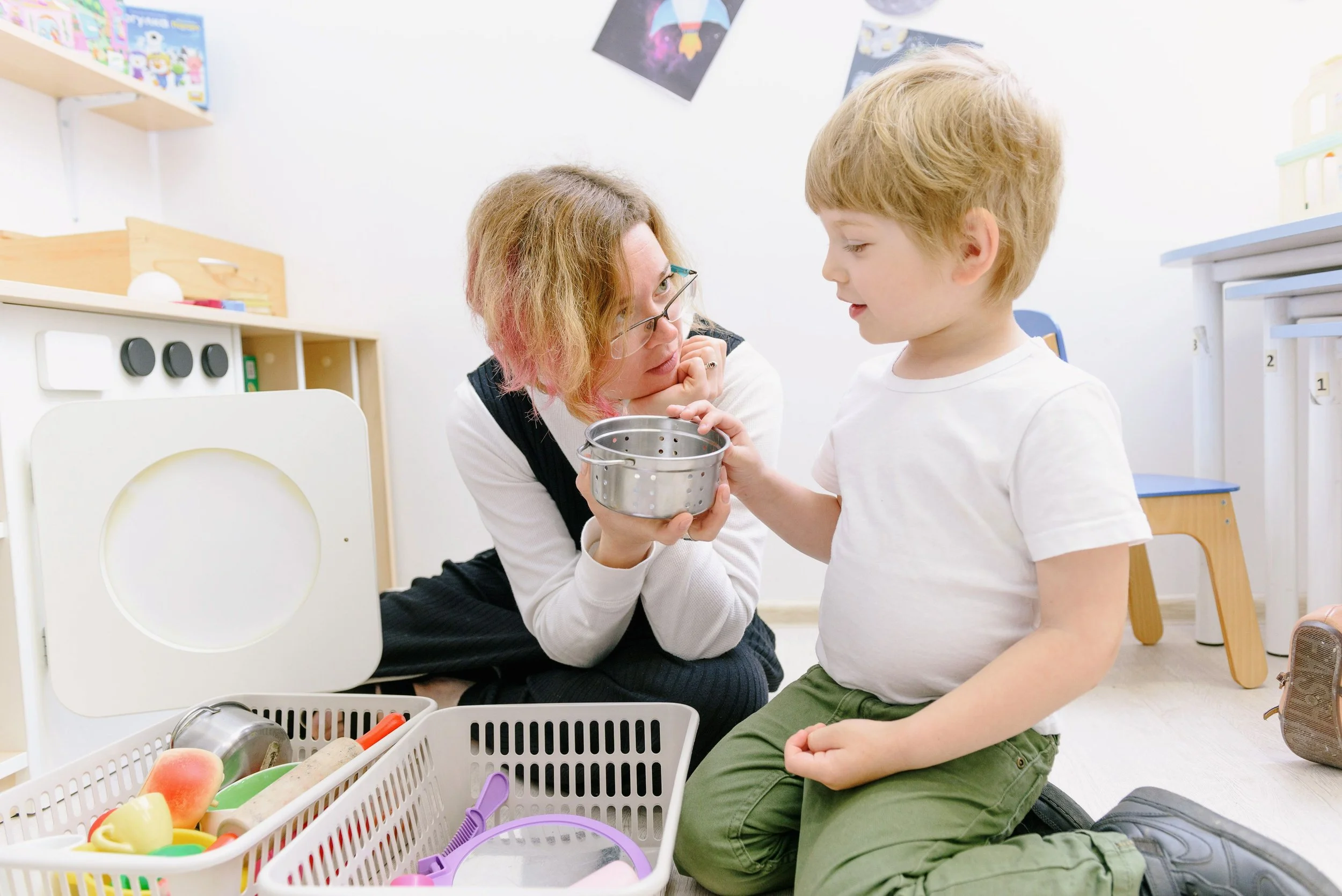
For children with selective mutism, even everyday classroom interactions can feel challenging. Teachers play an important role in helping children build comfort, participate in activities, and gradually develop communication skills. Learn practical strategies teachers can use to create positive connections and support children with selective mutism at school.
Most therapies happen once a week, but Selective Mutism is different. Children with SM need time to warm up, repeated opportunities to communicate, and caregivers who know how to support communication beyond the therapy room. Learn why we often begin with intensive treatment and how this approach helps build momentum, strengthen parent coaching, and create a foundation for expanding communication across home, school, and the community.
Since parents are the primary advocate for their children, it is important to understand what is available for children with SM, how to obtain those services, and which services are appropriate for your individual child. Here is an introduction to our “special education dictionary” to help you better understand the language and terminology your school may use.
Selective Mutism (SM) is an anxiety disorder characterized by consistent failure to speak in specific social situations. Kids with SM may struggle to speak at school, with adults, or with peers. They may have difficulty sharing personal information or making choices. Unfortunately, SM is not widely understood and neither are the important concepts that guide treatment for SM. Being a good consumer of treatment options will help you to be the best advocate for your child.
Selective Mutism (SM) is an anxiety disorder where a child is unable to speak in certain social situations, despite being able to talk in others. There is a noticeable and significant shift in a child’s speech across different settings.
Parent Books
The Organized Child by Richard Gallagher
Smart but Scattered by Peg Dawson and Richard Guare
Bright Kids Who Can't Keep Up by Ellen Braaten and Brian Willoughby
Child Books
Learning to Slow Down and Pay Attention by Kathleen Nadeau
Executive FUNction series by Bryan Smith
The Day Frankie Left His Frontal Lobes at Home by George and Laurie McCloskey

Organizations and Online Resources
Harvard University Center on the Developing Child

Reading Rockets Executive Functioning Page

LD Online Executive Functioning Page
Good grades don't always tell the whole story. In this first installment of our Things Parents Hear That Aren’t Quite Right series, we explore why understanding how a child learns can be just as important as what they achieve. Through a neuropsychological lens, we look beyond the report card to better understand the effort, strategies, and support that may be shaping a child's success.
If your child studies for hours but still struggles on tests, they’re not alone. Effective studying isn’t just about effort—it’s about matching how you study to how you’ll be tested. In this blog, we break down simple, practical ways to help your child study more effectively and build skills that actually stick.
If your child rereads and highlights but still struggles to remember what they study, they’re far from alone. Effective learning depends on active strategies—not passive ones—and students often need explicit teaching in how to preview, process, and explain new information. With the right tools and guidance, kids develop stronger comprehension and study habits that support them well beyond a single test.
When a child is avoiding doing their homework or procrastinating getting started, it is easy to come to the conclusion that they lack the motivation to get it done. Then, you offer an incentive to try and spark some sort of progress— “You can have an extra hour of screen time as soon as you get your homework done.” Not budging? There may be something a bit more complicated in play. Task avoidance is often caused by challenges with crucial emotional and executive functioning abilities.
Attention-Deficit/Hyperactivity Disorder (ADHD) is often thought of as simply a disorder of inattention or hyperactivity by the average person. However, ADHD is actually a disorder of overall regulation. These symptoms have the potential to bring a broad spectrum of challenges. What can make things even more complicated is navigating these challenges with a regular stream of negative feedback coming from seemingly all directions.
You’re seated right near the stage, watching the conductor lead the orchestra with rhythmic motions, pointing to the string instruments, to the woodwinds, to the bass… Just as the conductors so fluidly guides the orchestra to create beautiful compositions of music, so does our Executive Function guide our everyday thoughts and behaviors. Simply put, our executive function skills are imperative to our daily activity and functioning in the world around us.
Having ADHD does not define a person and there are skills, strategies, and other interventions to help those with ADHD thrive. The way we like to look at it is that ADHD is a disorder of regulation: dysregulation of attention, dysregulation of impulsivity, dysregulation of emotions. Our job is to give these kids the strategies to be able to better regulate so they can do what they need to do each and every day. The first step to helping them regulate is to understand the facts and myths behind ADHD.